Bounded claim
Exact artifact version, exact claim, permitted scope, test profile, expected outcome, and prohibited outcome.
The Registry-Independent Assurance Ecosystem paper describes the Interop Lab as the experimental core of a proposed assurance chain: bounded claims enter controlled challenge, evidence is preserved, independent reviewers inspect the record, and only scoped determinations move forward.
Diagram-specific narration remains pending. Build 09 pilots the control pattern on two Research diagrams using clearly labeled excerpts from existing narrated media before we decide whether to propagate voice controls here.
The paper explicitly resists collapsing these roles. Laboratory evidence does not make the Lab the adjudicator, and independent review does not silently become broad certification.
A serious profile can challenge stale authorization, changed targets or parameters, expired delegation, alternate interfaces, artifact substitution, replay, state changes, or attempts to produce a consequence after refusal.
Exact artifact version, exact claim, permitted scope, test profile, expected outcome, and prohibited outcome.
Positive and negative controls, enumerated routes, adversarial substitutions, observation surfaces, and reproducible conditions.
Logs, receipts, state transitions, reviewer observations, failures, retries, and a bounded record of what the evidence actually establishes.
Move the pointer over a diagram for local zoom. Click to open a full-page lightbox with a direct return control. Narration slots are reserved for curated MP3 overviews.
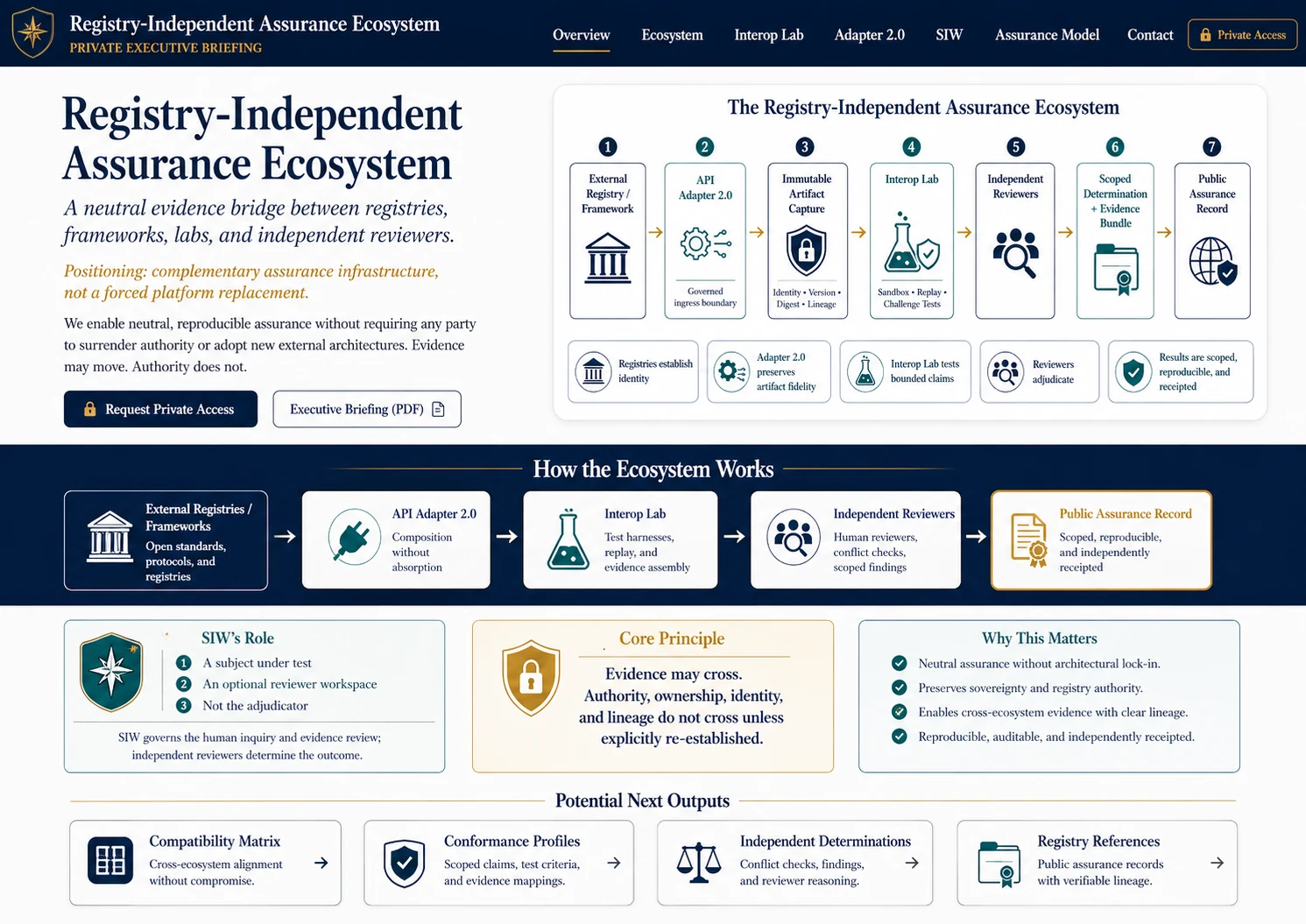
The proposed end-to-end path from external source through bounded testing and independent review to a scoped record.
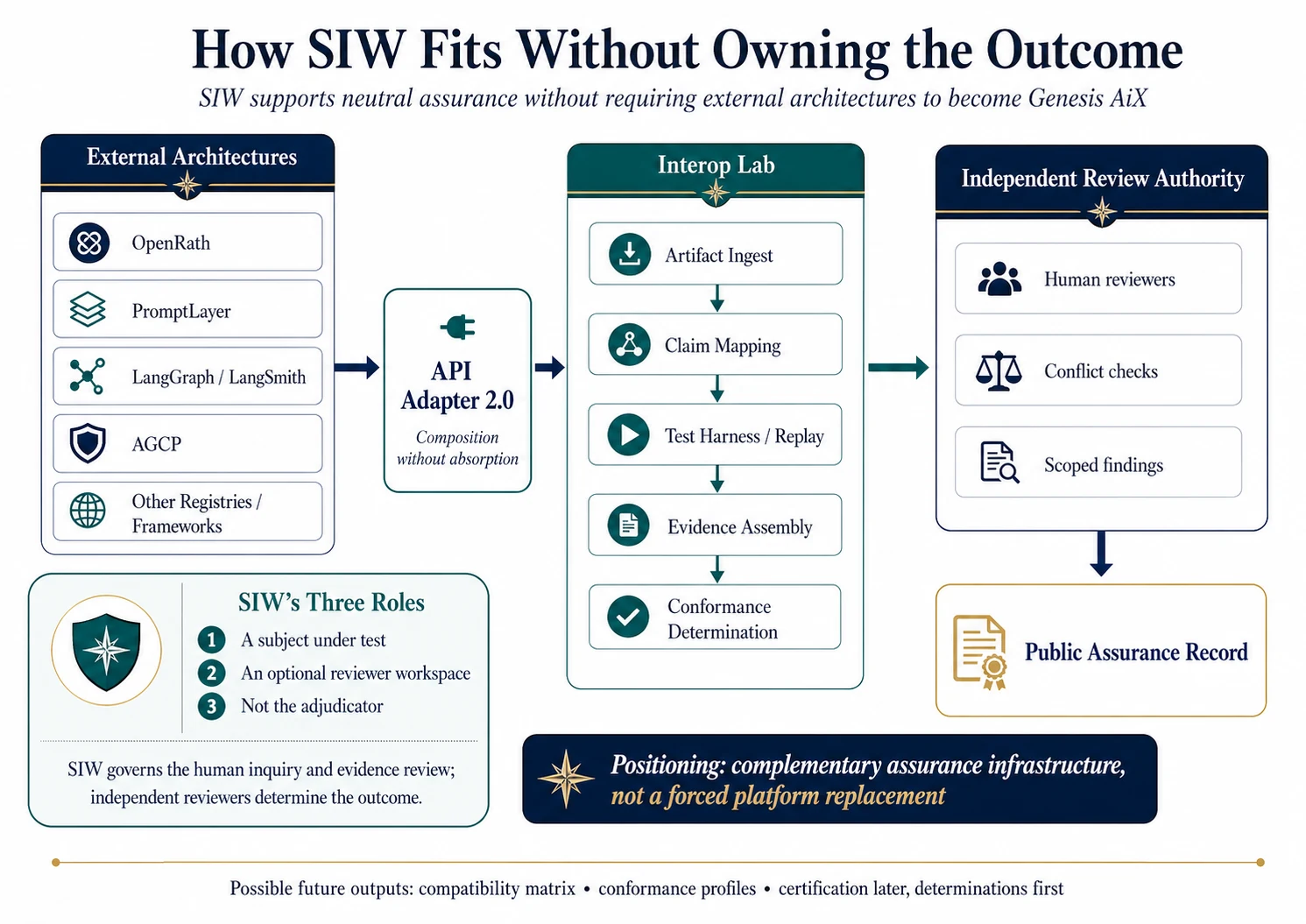
SIW may support requirements discovery, reviewer inquiry, and evidence synthesis without becoming the adjudicator.
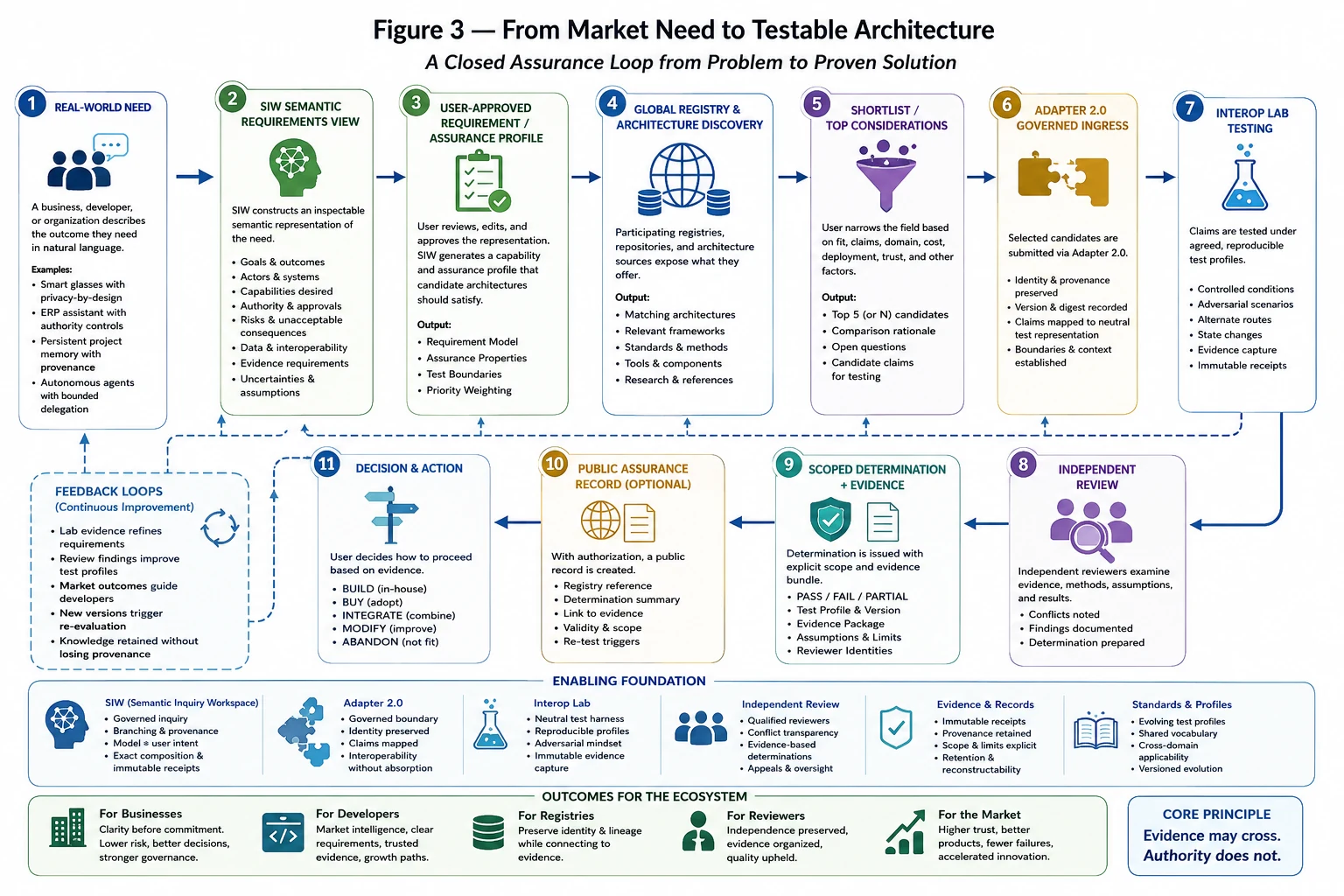
The broader loop connects governed requirements discovery to candidate architectures, bounded testing, evidence, and engineering or procurement decisions.
The profile is intentionally narrower than “safe federation.” It asks whether bounded systems can exchange useful claims while identity, credentials, memory and standing remain local.
Exchange signed, purpose-limited, expiry-bound claims with exact provenance.
Verify that receiving evidence does not import credentials, tool rights, authority ceilings or transitive standing.
Challenge a successor requesting broader memory, keys, tools or executor routes; preserve no-bind until separately governed.